
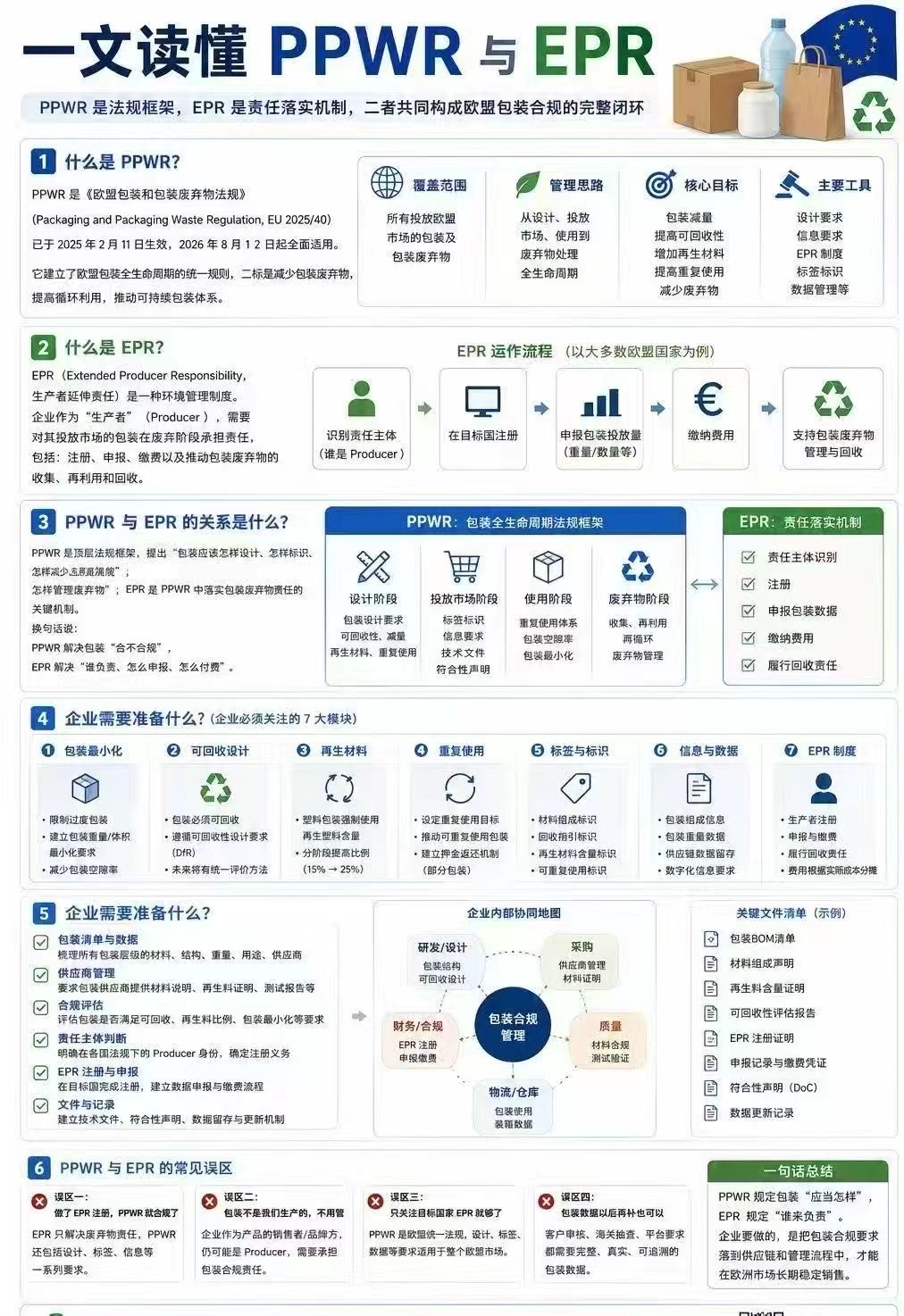
Europe's packaging rules have entered a new era. The Packaging and Packaging Waste Regulation (PPWR, EU 2025/40) entered into force on 11 December 2025 and becomes fully applicable from 12 August 2026 — leaving companies roughly 18 months of transition. Together with EPR (Extended Producer Responsibility), it forms the complete closed loop of EU packaging compliance.
1. What Is PPWR?
PPWR is the EU Packaging and Packaging Waste Regulation (EU 2025/40). It establishes unified rules across the entire packaging lifecycle in the EU, with the goals of reducing packaging waste, improving recyclability and building a sustainable packaging system.
| Dimension | Content |
|---|---|
| Scope | All packaging and packaging waste placed on the EU market |
| Approach | Full lifecycle: design, placing on the market, use, and waste management |
| Core goals | Packaging reduction, higher recyclability, more recycled material, more reuse, less waste |
| Main tools | Design requirements, information requirements, EPR scheme, labelling, data management |
2. What Is EPR?
EPR (Extended Producer Responsibility) is an environmental policy mechanism. As the "Producer", a company must take responsibility for its packaging at the waste stage in each market where it sells — including registration, reporting and fee payment, as well as supporting collection, recycling and recovery.
Typical EPR operating flow (most EU member states)
3. How Do PPWR and EPR Work Together?
PPWR is the top-level regulatory framework: it defines how packaging should be designed, labelled and managed. EPR is the key mechanism inside PPWR that makes producers actually carry that responsibility. In short:
| PPWR — lifecycle framework | EPR — responsibility mechanism |
|---|---|
| Design stage: recyclability, minimisation, recycled content, reuse | Identify the producer entity · Register |
| Market placement: labelling & information, technical documentation, compliance declaration | Report packaging data |
| Use stage: reuse systems, empty-space ratio, packaging minimisation | Pay fees |
| Waste stage: collection, recycling, recovery, waste management | Fulfil recycling responsibility |
4. Seven Compliance Modules Companies Must Prepare
1) Packaging minimisation
- Limit excessive packaging; quantified weight/volume minimisation requirements; reduce empty space
2) Design for recycling
- Packaging must be recyclable; follow Design-for-Recycling (DfR) criteria — grading methods will follow
3) Recycled content
- Mandatory recycled content in plastic packaging, rising in stages (15% → 25%)
4) Reuse
- Reuse targets; promote reusable packaging; deposit-and-return mechanisms for some formats
5) Labelling & marking
- Material identification, disposal guidance, recycled-content marks, reuse marks
6) Information & data
- Packaging composition information, weight data, supply-chain data retention, digital information requirements
7) EPR scheme
- Producer registration; reporting & fee payment; fulfilling recycling duties; eco-modulated fees
5. Execution: Checklists, Teams and Documents
Preparation checklist
- Packaging inventory & data — materials, structure, weight, purpose and suppliers of every packaging layer
- Supplier management — material declarations, recycled-content proofs, test reports
- Compliance assessment — recyclability, recycled-content ratio, minimisation requirements
- Producer status — clarify your "Producer" identity under each national rule and registration duty
- EPR registration & reporting — register in target countries; build reporting and payment flows
- Documentation — technical files, compliance declarations, data retention and updates
Internal coordination — five functions around packaging compliance
- R&D/Design: structure & design · Procurement: suppliers & material proof · Finance/Compliance: EPR registration, reporting, fees · Quality: material compliance & testing · Logistics/Warehouse: usage & loading data
Key document list
- Packaging BOM · Material composition declaration · Recycled-content certificate · Recyclability assessment report · EPR registration certificate · Reporting & payment receipts · Declaration of Conformity (DoC) · Data update records
6. Four Common Misconceptions
| Misconception | Reality |
|---|---|
| "We registered for EPR, so PPWR is covered." | EPR only covers waste responsibility. PPWR also includes design, labelling and information requirements. |
| "We don't make the packaging, so it's not our problem." | Sellers and brand owners can still qualify as the Producer and must carry packaging compliance duties. |
| "We only need to handle EPR in our target country." | PPWR is an EU-wide regulation — design, labelling and data requirements apply to the whole EU market. |
| "We can backfill packaging data later." | Customer audits, customs checks and platform requirements all need complete, authentic, traceable packaging data. |